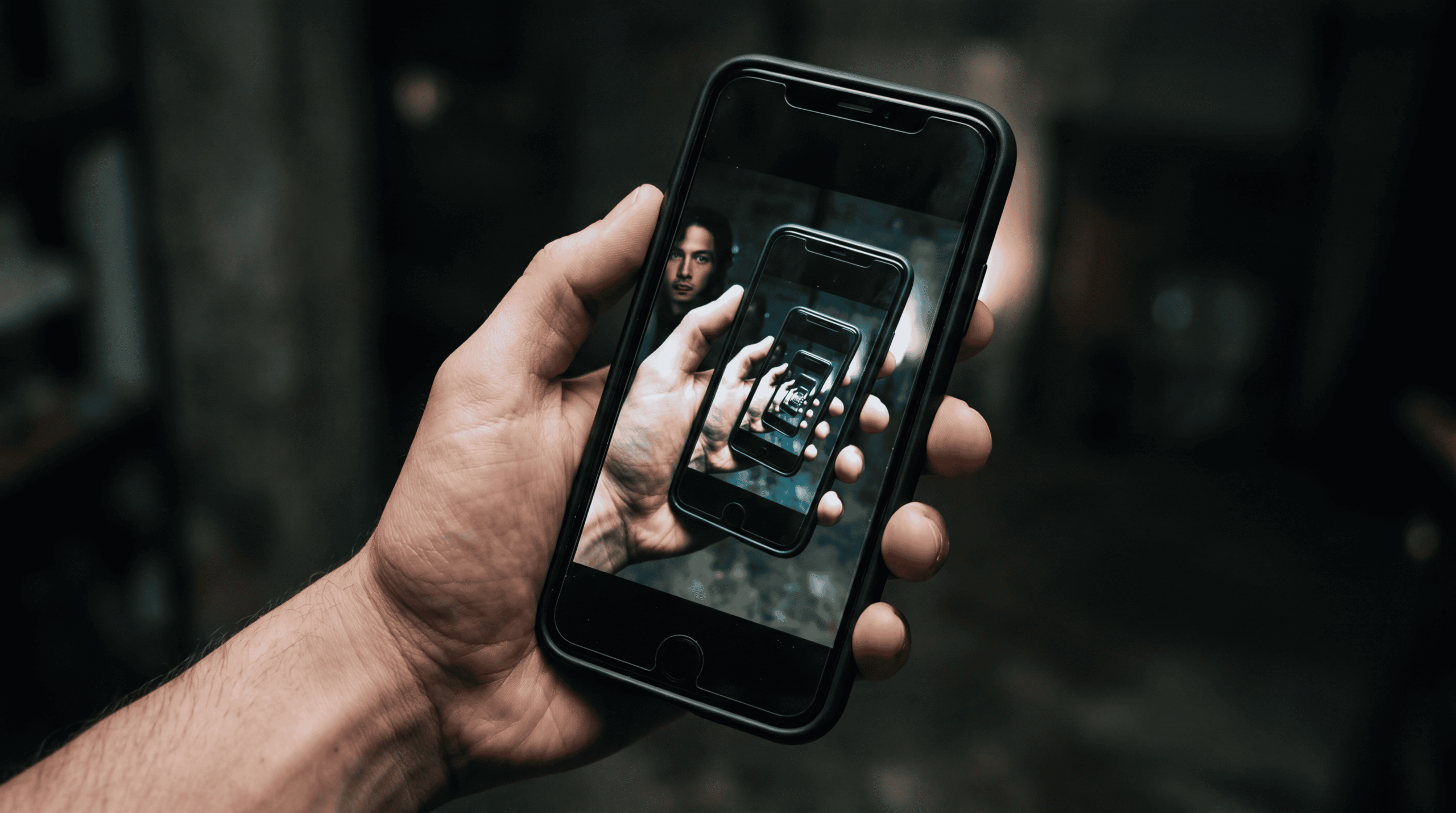

You’ve done it without realizing. You saw a screenshot of someone’s message, a photo of a photo, a meme with someone’s face—and your brain quietly decided that person was less real than if you’d seen the original image.
Psychologists call this the Medusa effect, named after the mythological figure who turned people to stone. When you view someone through layers of representation—a picture of a picture—your mind unconsciously petrifies them, stripping away their humanity one layer at a time.
And it’s happening everywhere you look online.
The Representation Distance Problem
Here’s what your brain is doing without your permission: It’s calculating representational distance—how many steps removed you are from direct reality. A person standing in front of you has zero distance. A photograph has one layer. A screenshot of that photograph? Two layers.
And with each layer, your brain treats the subject as less capable of thought, feeling, and suffering.
Research published in the Journal of Experimental Psychology demonstrates this effect with uncomfortable clarity. When participants viewed original photographs of people, they attributed normal levels of mental capacity—the ability to experience emotions, make plans, and feel pain. But when shown those same faces in screenshots or photos-of-photos, something shifted.
The people in the twice-removed images were rated as having significantly less mental experience. Not dramatically less—but measurably, consistently less. Enough to matter.
Why Your Brain Builds This Distance
This isn’t a glitch in your psychology. It’s a feature—one that evolved long before smartphones existed.
Your brain uses processing fluency as a shortcut for reality. Things that feel immediate and direct trigger your empathy systems. Things that feel distant or abstract don’t. When you see someone through multiple frames—a screenshot within a tweet within an article—your brain registers each frame as a barrier between you and that person’s actual experience.
The psychological mechanism at work is called attribution substitution. Your brain is supposed to answer a hard question: “Is this person real and deserving of empathy?” Instead, it answers an easier question: “Does this feel real and immediate?”
A photo-of-a-photo doesn’t feel immediate. So your unconscious mind downgrades the person inside it.
The Research Says
The original Medusa effect study, conducted by researchers at the University of Toronto and published in early 2025, tested this across multiple experiments. They showed participants either original digital images or those same images photographed again (creating a “picture of a picture” effect).
The results held across different types of images—faces, bodies, people in various contexts. The layer of re-representation consistently reduced attributions of mental capacity by 8-12%, depending on the measure.
Even more revealing: When researchers explicitly told participants they were looking at a “screenshot” versus an “original photo,” the effect persisted. Knowing about the layer didn’t eliminate its psychological impact. Your conscious awareness can’t override this bias.
Related research on psychological distance and moral judgment from behavioral science labs shows that any increase in perceived distance—temporal, spatial, or representational—reduces empathic concern and moral obligation. The Medusa effect is this principle manifesting in how we process digital images.
Where This Shows Up In Your Life
Think about where you encounter pictures-of-pictures most often. Social media screenshots. Memes made from someone’s photo. News articles showing tweets showing photos. WhatsApp forwards. Reddit posts. Every major platform is built on re-sharing images that have already been captured, framed, and shared elsewhere.
Each time content gets re-shared with a new frame around it, the people inside become slightly less human to your brain. This is why it’s easier to mock someone in a screenshot than someone whose photo you’re viewing directly. This is why viral shaming feels different from in-person confrontation.
The representational distance gives you psychological permission to engage with cruelty that would feel wrong if the barrier weren’t there.
Consider cancel culture dynamics. When someone’s worst moment gets screenshot, turned into a meme, and shared thousands of times, each re-sharing adds another layer of distance. The person becomes an abstraction—a symbol of wrongdoing rather than a human who made a mistake.
Your brain isn’t registering “person who said something wrong.” It’s registering “image-within-image-within-image of person who represents a concept I disagree with.” The humanity has been compressed out through representational layers.
The Empathy Erosion You Don’t Notice
The Medusa effect doesn’t make you consciously think “this person isn’t human.” That would be obvious, and you’d correct it. Instead, it operates at the level of implicit cognition—the automatic judgments that happen before conscious thought.
You still know the person in the screenshot is human. But your emotional systems and moral intuitions treat them as slightly less so. You’re less likely to imagine their internal experience. Less likely to consider their perspective. Less likely to extend benefit of the doubt.
Research on dehumanization in digital spaces shows this is cumulative. The more time you spend engaging with heavily re-shared, multiply-framed content, the more your baseline empathy calibration shifts. You don’t become cruel—you become slightly more indifferent, slightly less quick to recognize suffering.
And because everyone around you is experiencing the same shift, it becomes the new normal. The Medusa effect is a collective recalibration of how much humanity we attribute to people we encounter through screens.
Why Platforms Amplify This
Social media companies didn’t create the Medusa effect, but their design choices exploit it ruthlessly. Every interface element that adds visual distance—borders, frames, quote-tweet structures, story-within-story formats—increases representational distance.
When you see someone’s face in their direct Instagram post, there’s one layer. When you see a screenshot of that post shared in a Facebook group with commentary, there are three layers: original photo, Instagram frame, Facebook re-share frame. When someone screenshots that and shares it on Twitter? Four layers.
At four layers of representation, the psychological research suggests the person in the original image has lost roughly 30-40% of the mental capacity your brain automatically attributes to people you see directly.
This isn’t accidental. Engagement metrics favor content that triggers reaction over reflection. Content that makes you feel distant enough to judge quickly, comment harshly, share without guilt. The Medusa effect provides the psychological infrastructure for virality.
The Technology Makes It Worse
Your grandparents had to work hard to create representational distance. Photocopying a photo, then photographing the photocopy, was effort. Now it takes one tap. Screenshot, crop, share—you’ve added a layer of psychological distance in under three seconds.
The American Psychological Association has raised concerns about how ease-of-sharing on digital platforms might be eroding empathy development, particularly in younger users who have never known a world without multiply-layered image sharing.
When the barrier between seeing someone and creating psychological distance from them is effectively zero, that distance becomes your default. You stop having to choose dehumanization—it becomes the path of least resistance.
What This Means For Your Empathy
The uncomfortable truth: You are less kind to people you encounter through screenshots than people you encounter through original images. Not because you’re a bad person, but because your brain is doing what brains do—using representational distance as a proxy for “how much should I care about this person’s experience?”
The Medusa effect is strongest when you’re already predisposed to judgment. If you see a screenshot of someone you politically disagree with, the representational distance makes it easier to dismiss their humanity. If you see a meme made from a stranger’s embarrassing moment, the layers of framing make it easier to laugh without guilt.
This is how ordinary people participate in cruelty without feeling cruel. The psychological distance created by image layering provides moral cover that your conscious mind doesn’t even register.
The Feedback Loop
Here’s where it gets darker: The Medusa effect creates a feedback loop with confirmation bias. When you see people through representational distance, you’re less likely to update your beliefs about them because you’re less likely to engage with them as complex humans capable of growth or nuance.
Screenshots show moments frozen in time, removed from context, framed by someone else’s interpretation. Your brain processes this package as “fixed truth about a simplified person” rather than “one moment in a complex human’s life.”
The layering literally makes people look more two-dimensional to your psychological processing systems. And two-dimensional people don’t deserve three-dimensional empathy.
Try This Today
Before you share a screenshot of someone—whether to mock, criticize, or even celebrate them—do this: Find and look at their original content directly, without the framing layers.
Go to the actual profile. See the person’s face in their own chosen context. Read what they said in their full feed, not cropped into someone else’s commentary. Spend 30 seconds seeing them as the poster of content, not the content itself.
You’ll notice something shift in your gut. Not always—sometimes people really do deserve criticism. But often enough, you’ll feel the representational distance collapse, and suddenly the person becomes real again.
That feeling? That’s your empathy system coming back online. That’s what the Medusa effect has been quietly suppressing every time you engaged with someone through layers of representation.
The next time someone exists for you only as a screenshot in a screenshot, remember: Your brain has already decided they’re less human than they actually are, and you never got a choice in the matter.