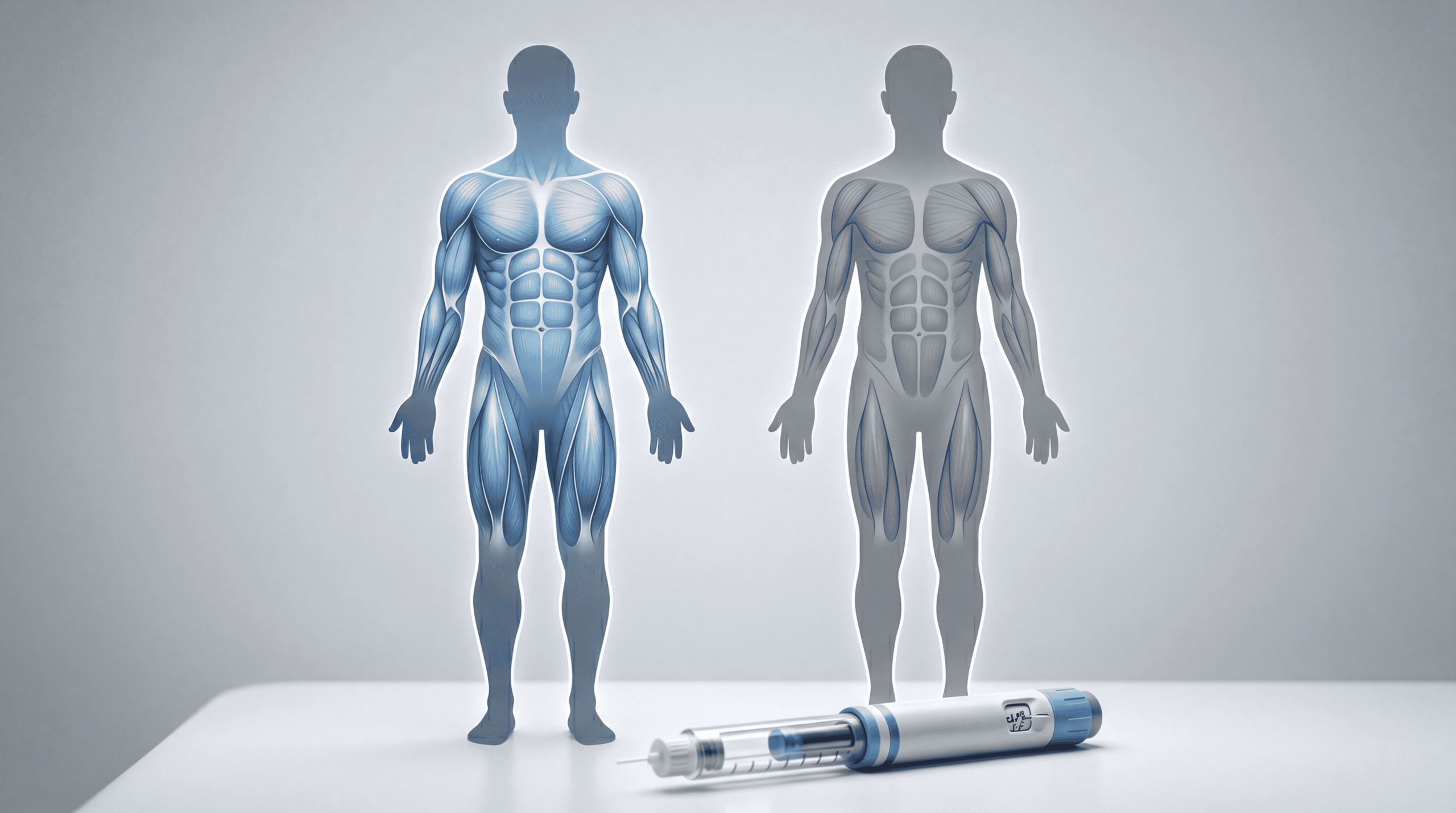

The panic about GLP-1 medications causing catastrophic muscle loss is overblown—but the solution requires more effort than most doctors are prescribing. As a physician who’s guided hundreds of patients through weight loss with semaglutide and tirzepatide, I’ve watched the media cycle through hysteria about these drugs turning people into “skinny-fat” metabolic wrecks. The truth is more nuanced and far more actionable than the headlines suggest.
Why GLP-1 Medications Affect Muscle Mass at All
When you lose weight—through any method—you always lose some lean body mass along with fat. This isn’t unique to GLP-1 receptor agonists like Ozempic (semaglutide) or Mounjaro (tirzepatide). The fundamental issue is that rapid caloric restriction triggers your body to break down both adipose tissue and muscle protein for energy.
Here’s the mechanism: GLP-1 drugs dramatically suppress appetite through multiple pathways—delaying gastric emptying, reducing ghrelin secretion, and directly signaling satiety in the hypothalamus. This works brilliantly for weight loss but creates a metabolic challenge. When caloric intake drops suddenly from 2,500 to 1,200 calories daily (common with these medications), your body enters a catabolic state where muscle protein synthesis decreases while muscle protein breakdown continues or even accelerates.
The STEP 1 clinical trial published in The New England Journal of Medicine showed that patients on semaglutide lost an average of 15% of their body weight, with approximately 39% of that loss coming from lean mass. That’s actually better than many crash diets, which can see 50% or more of weight loss from muscle, but it’s still clinically significant.
What The Media Got Wrong About GLP-1 and Muscle
The fearmongering headlines missed three critical points. First, they compared GLP-1 muscle loss to doing nothing—the wrong baseline. The correct comparison is against other weight loss methods, where GLP-1 drugs actually preserve more muscle than severe caloric restriction alone.
Second, they ignored that muscle loss is preventable with proper intervention. The studies showing significant lean mass reduction used protocols with no structured resistance training or protein optimization. That’s medical malpractice by design, not an inevitable outcome of the medication.
Third, they confused absolute muscle loss with relative body composition. If you lose 50 pounds—35 pounds of fat and 15 pounds of muscle—your muscle-to-fat ratio may actually improve even though absolute muscle mass decreased. Context matters enormously here.
The Biological Reality: Your Muscle Needs Three Signals
Muscle tissue responds to three primary anabolic signals: mechanical tension, adequate amino acids, and anabolic hormones. GLP-1 medications don’t directly interfere with any of these, but the appetite suppression indirectly compromises two of them.
When you’re not hungry, you naturally eat less protein. Most patients I see on semaglutide drop to 40-60 grams of protein daily without intervention—nowhere near the 1.6-2.2 grams per kilogram of body weight needed to maintain muscle during weight loss. Additionally, the profound satiety often eliminates the post-workout hunger that normally drives recovery nutrition.
Mechanical tension—the signal your muscles receive from resistance training—becomes even more critical during caloric restriction. Without it, your body has no reason to preserve metabolically expensive muscle tissue when energy is scarce. This is basic evolutionary physiology: unused tissue gets catabolized first.
The Protocol That Actually Works
Based on emerging research and clinical experience, here’s what preserves muscle mass during GLP-1 treatment. A 2024 study in Obesity Science & Practice demonstrated that structured resistance training three times weekly combined with high protein intake reduced lean mass loss from 39% to 21% of total weight lost—a dramatic improvement.
The resistance training must create genuine mechanical stress. We’re talking about progressive overload with compound movements—squats, deadlifts, rows, presses—not pink dumbbells and endless cardio. Your muscles need a clear signal that they’re necessary for survival. Two to three sessions weekly of 45-60 minutes, focusing on major muscle groups, hitting each movement pattern twice per week minimum.
Protein intake needs to be aggressive and strategic. I recommend 1.8-2.2 grams per kilogram of ideal body weight (not current weight if you’re obese), distributed across at least three meals. This typically means 120-160 grams daily for most patients. Yes, this feels difficult when you’re not hungry—that’s precisely why it requires deliberate effort and often protein supplementation.
The Supplement Question: What Actually Has Evidence
The supplement industry has predictably flooded the market with “muscle-saving” products for GLP-1 users. Most are garbage. However, three interventions have legitimate evidence.
Creatine monohydrate (5 grams daily) has decades of research supporting muscle preservation during caloric restriction. It works by increasing intramuscular phosphocreatine stores, which improves training performance and promotes muscle protein retention. It’s cheap, safe, and one of the most studied supplements in existence.
Leucine or branched-chain amino acids may provide additional benefit for patients who struggle to hit protein targets through whole foods. A 2023 meta-analysis in the Journal of the International Society of Sports Nutrition showed that leucine supplementation (3-4 grams with meals) enhanced muscle protein synthesis in calorie-restricted states. This isn’t magic—it’s simply ensuring adequate essential amino acids when appetite is suppressed.
Vitamin D optimization matters more than most realize. Vitamin D receptors exist on muscle tissue, and deficiency (common in obese patients) impairs muscle protein synthesis. Get your levels tested and supplement to achieve 40-60 ng/mL. This typically requires 2,000-4,000 IU daily for most patients.
What You Should Actually Do
If you’re starting or currently taking a GLP-1 medication, implement this four-part protocol immediately. First, begin resistance training with a qualified coach or physical therapist who understands progressive overload. Don’t wait until you’ve “lost some weight first”—that’s when muscle loss accelerates.
Second, track your protein intake obsessively for at least the first month until it becomes habitual. Use an app like Cronometer or MyFitnessPal. Front-load protein early in the day when appetite suppression may be less severe. Many patients find protein shakes necessary to hit targets—that’s fine. Whole foods are ideal, but hitting the number matters more than the source.
Third, request a DEXA scan or bioimpedance analysis before starting GLP-1 therapy and every 3-4 months during treatment. This provides objective data on body composition changes, not just scale weight. You want to see fat mass decreasing while lean mass remains stable or increases slightly. If lean mass drops more than 25% of total weight lost, your protocol needs adjustment.
Fourth, work with a physician or dietitian who understands body composition, not just weight loss. Too many prescribers hand out semaglutide prescriptions without any discussion of protein, resistance training, or lean mass preservation. That’s inadequate care. The American Association of Clinical Endocrinologists guidelines explicitly recommend exercise and nutrition counseling with GLP-1 therapy, but compliance is abysmal.
The Long-Term Reality Check
Here’s what nobody wants to hear: maintaining muscle mass on GLP-1 medications requires sustained effort that many patients won’t maintain. The drugs make weight loss effortless; muscle preservation is not effortless. It requires consistent training, deliberate protein intake despite no appetite, and ongoing monitoring.
The patients I see who maintain excellent body composition on these medications are the ones who treat resistance training like a prescription—non-negotiable, scheduled, progressive. They prep protein-rich meals in advance. They recognize that the appetite suppression is both the drug’s greatest benefit and its potential downside.
Conversely, patients who just “take the shot and see what happens” typically lose weight but emerge with poor muscle mass, reduced metabolic rate, and functional decline. They may look smaller but feel weaker, tire more easily, and face higher risk of regaining weight when they stop the medication.
When Muscle Loss Becomes Medically Concerning
Some muscle loss during rapid weight reduction is expected and acceptable. However, certain thresholds warrant intervention. If lean mass loss exceeds 40% of total weight lost, that’s a red flag. If you’re experiencing functional decline—difficulty climbing stairs, reduced grip strength, persistent fatigue beyond the first month—that suggests excessive muscle catabolism.
Older adults (over 65) need particular vigilance. Age-related sarcopenia combined with GLP-1-induced weight loss can accelerate functional decline and increase frailty risk. For these patients, I typically recommend slower dose escalation, even more aggressive protein targets (2.2-2.5 g/kg), and earlier intervention with physical therapy.
Blood markers can provide additional insight. Low albumin, prealbumin, or transferrin levels suggest inadequate protein intake and malnutrition. If these appear, we need to slow down weight loss, increase protein dramatically, or potentially reduce the GLP-1 dose. Rapid weight loss at any cost isn’t the goal—sustainable body composition improvement is.
The Future: Combination Therapies
The pharmaceutical industry recognizes this muscle loss problem. Several companies are developing combination therapies pairing GLP-1 agonists with muscle-preserving or muscle-building agents. Early trials combining semaglutide with selective androgen receptor modulators (SARMs) or myostatin inhibitors show promise but remain years from clinical availability.
Growth hormone secretagogues represent another avenue. A 2024 pilot study examined adding low-dose ibutamoren (a GH secretagogue) to tirzepatide therapy and found improved lean mass retention without compromising fat loss. However, this remains experimental and carries its own side effect profile.
For now, we’re left with the proven basics: resistance training and high protein intake. It’s not sexy, it’s not easy, but it’s what the physiology demands. No pharmaceutical shortcut changes that fundamental requirement.
Your One Actionable Takeaway
Before your next GLP-1 injection, schedule three resistance training sessions for the coming week and calculate your protein target in grams—then treat both as seriously as you treat the medication itself, because maintaining the muscle you have is far easier than rebuilding what you lose.