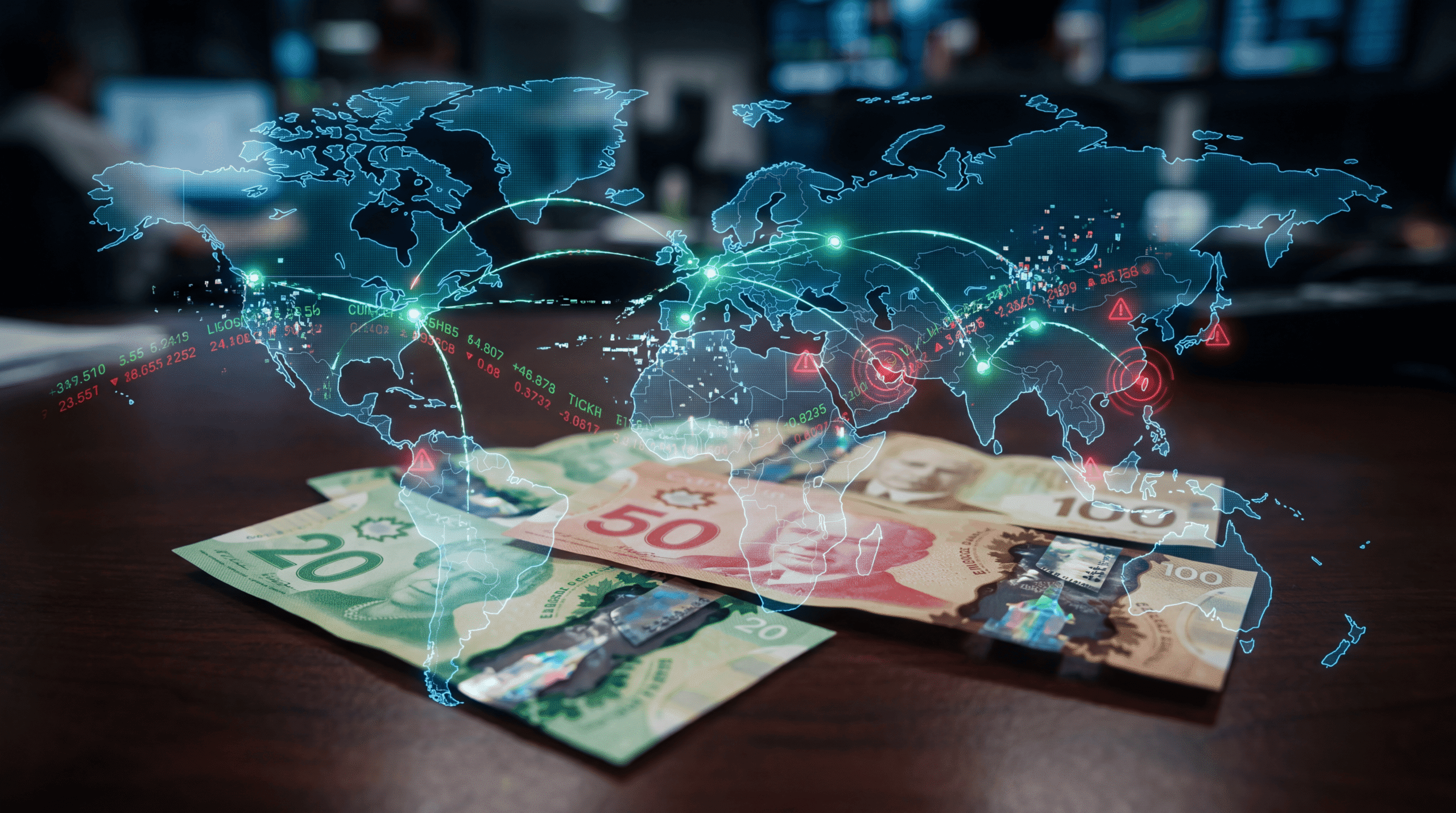

The central bank that spent two years fighting inflation just admitted something more dangerous is lurking: the global order itself is fracturing, and Canada’s financial system is in the blast radius.
The Bank of Canada’s December 2024 Financial System Review doesn’t bury the lead. For the first time in recent memory, geopolitical risk tops the list of threats to Canadian financial stability — ranking above household debt, above commercial real estate stress, above cyber threats. This isn’t abstract concern. This is the institution that manages $120 billion in assets telling you the rules of global finance are being rewritten in real time, and not peacefully.
The Empire Strikes Back: What Changed
Three years ago, central bankers treated geopolitics like weather — unpredictable, sure, but ultimately external to their models. That consensus died somewhere between Kyiv and Gaza. The Bank’s report identifies four specific channels through which geopolitical instability now threatens Canadian prosperity: trade disruption, commodity price shocks, financial market contagion, and what they delicately call “fragmentation of the global financial architecture.”
Translation: the dollar-dominated system that made Canadian trade predictable is fracturing, and nobody has agreed on what comes next. When Saudi Arabia and China start settling oil contracts in yuan, when BRICS nations discuss alternative payment rails, when the G7 can’t coordinate sanctions without massive exemptions — that’s not background noise. That’s the sound of the post-1945 order cracking.
The Bank of Canada’s analysis reveals something officials rarely say aloud: monetary policy is losing its potency because the transmission mechanisms assume a stable geopolitical environment. You can raise interest rates all day, but if supply chains are weaponized and energy markets are hostage to military calculations, inflation becomes ungovernable through traditional tools.
The Taiwan Scenario Nobody Wants to Model
Here’s what keeps Deputy Governor Toni Gravelle awake: Taiwan Semiconductor Manufacturing Company produces 90% of the world’s advanced chips. A single military confrontation in the Taiwan Strait would make the 2021 chip shortage look like a minor inconvenience. Canadian auto production, already fragile, would collapse within weeks. Banking systems dependent on next-generation processors would face rationing. The financial sector’s stress tests don’t currently model this scenario because the answer is too ugly.
The Council on Foreign Relations estimates a Taiwan conflict would reduce global GDP by 10% in the first year — double the 2008 financial crisis impact. For Canada, export-dependent and integrated into U.S. supply chains, the multiplier effect would be catastrophic. Yet central banks can’t hedge this risk. There’s no monetary policy response to jets scrambling over the Taiwan Strait.
The Bank’s report diplomatically notes “increased uncertainty around global supply chains,” but the subtext screams: companies are friend-shoring and reshoring at speed, even when economically irrational, because they’ve concluded geopolitical risk trumps cost efficiency. When CFOs make decisions based on war scenarios rather than quarterly earnings, you’re already in a different economic regime.
Energy: The Weapon That Keeps on Giving
Remember when energy markets were about supply and demand? That era ended February 24, 2022. Today, every barrel of oil, every cubic meter of natural gas, every lithium deposit carries geopolitical weighting. Canada sits on immense energy resources but faces a paradox: global buyers now care as much about political stability as price.
The Bank’s assessment of commodity price volatility understates the structural shift. Russia’s redirection of energy flows toward Asia didn’t just change trade routes — it created parallel pricing mechanisms. There’s now a “Western” oil price and an “everyone else” oil price, with spreads reaching $20 per barrel. Financial models built on unified commodity markets are increasingly fiction.
For Canada, this creates both opportunity and vulnerability. As Europe desperately diversifies away from Russian energy, Canadian LNG becomes strategically precious. But that same strategic value makes energy infrastructure a potential target — not militarily, but through cyber operations, domestic pressure campaigns, and regulatory warfare. When your biggest economic asset becomes a geopolitical chess piece, volatility is the new normal.
What This Means For You
If you’re a Canadian homeowner, you’ve watched mortgage rates with understandable anxiety. But geopolitical risk introduces a different calculation: even if the Bank of Canada cuts rates as expected, borrowing costs may not fall proportionally because risk premiums are rising elsewhere in the system. Banks are quietly building geopolitical buffers into their lending models.
If you’re invested in the TSX, look beyond quarterly earnings. Energy and materials stocks now carry implicit geopolitical optionality — they’re essentially long volatility plays. Technology stocks face the opposite exposure: any supply chain disruption in Asia hits Canadian tech harder than U.S. competitors because we lack domestic semiconductor capacity.
If you’re a small business owner dependent on imports, the message is stark: supply chain resilience now costs more than supply chain efficiency, and that cost is permanent. The era of just-in-time inventory assumed geopolitical stability. That assumption is dead. Companies that haven’t modeled “what if China” scenarios are operating blind.
The Dollar Dilemma
The Bank of Canada doesn’t explicitly discuss de-dollarization in the report, but the implications ripple through every page. Canada conducts 75% of trade in U.S. dollars, but increasingly with partners looking to diversify away from dollar dependence. This creates a particularly Canadian vulnerability: we’re tied to the dollar system by proximity and history, but exposed to the consequences of its erosion.
Recent analysis from Foreign Affairs suggests dollar dominance will persist but become more contested and expensive to maintain. For Canada, that means higher transaction costs, more currency volatility, and growing pressure to develop alternative payment relationships — particularly with Asian trading partners who are already building non-dollar infrastructure.
The truly destabilizing scenario isn’t dollar collapse — it’s dollar coexistence with rival systems. A world where some transactions clear in dollars, others in yuan, others in digital currencies, and still others in commodity-backed instruments is a world where currency risk becomes unhedgeable for mid-sized economies like Canada. The Bank of Canada knows this. They just can’t say it plainly without triggering the very capital flight they fear.
The Debt Time Bomb Gets a Geopolitical Fuse
Canadian household debt sits at 180% of disposable income — a number that looks manageable in peacetime with predictable rate cycles. But geopolitical shocks don’t follow rate-cycle logic. They arrive as discontinuous surprises that make careful financial planning look like hubris.
The Bank’s analysis of household vulnerabilities focuses on interest rate sensitivity, but the real danger is income shock combined with rate shock. A trade war that kills manufacturing jobs while geopolitical risk keeps rates elevated would expose millions of households simultaneously. The stress tests model gradual deterioration. Geopolitics delivers sudden ruptures.
Commercial real estate adds another layer of fragility. Office towers financed at 2% now refinancing at 5% face challenges even in stable times. Add the possibility of cyber attacks on critical infrastructure, supply chain breakdowns affecting construction, or sudden capital flight from perceived geopolitical risk, and you have a sector perched on a knife edge. The Bank sees this. Their repeated references to “tail risks” are central banker code for “we see scenarios we can’t fully prepare for.”
What Happens Next: Three Scenarios
Scenario One: Managed Decline (40% probability) — The current trajectory continues. Geopolitical tensions remain elevated but contained. Trade slowly fragments into regional blocs. Canada navigates by deepening USMCA ties while carefully maintaining Asian relationships. Financial volatility increases but remains within historical bounds. The Bank of Canada maintains credibility through careful communication and limited intervention. This is the “muddle through” option — survivable but not comfortable.
Scenario Two: Acute Crisis (35% probability) — A single catalyzing event — Taiwan, a major cyber attack, sudden dollar crisis, or Middle East conflagration — triggers the kind of synchronized global shock we haven’t seen since World War II. Canadian financial markets seize as global counterparties freeze transactions pending clarity. The Bank of Canada faces impossible choices: defend the currency or inject liquidity, but not both simultaneously. Emergency measures last months, not weeks. The economic damage exceeds 2008 because the cause is geopolitical, not financial, meaning traditional crisis tools don’t work cleanly.
Scenario Three: Fragmented Stability (25% probability) — Geopolitical competition intensifies but finds uneasy equilibrium. A new concert of powers emerges with implicit rules — proxy conflicts permitted, direct confrontation avoided, parallel financial systems tolerated. Canada successfully positions as a trusted middle power, benefiting from energy exports and political stability while both U.S. and Asian blocs court favor. Financial volatility remains elevated but becomes more predictable. This is the best realistic outcome, but requires diplomatic sophistication Canada hasn’t consistently demonstrated.
The Question Nobody Wants to Answer
The Bank of Canada’s Financial System Review is ultimately a document about control — specifically, the growing recognition that central banks are losing it. Not because of policy failures, but because the assumptions underlying monetary policy are being invalidated by forces central banks cannot influence.
When Governor Tiff Macklem says the Bank is “carefully monitoring global developments,” he means: we see the storm forming, we know our tools are designed for different weather, and we’re not sure what happens if the big one hits. That’s not weakness. That’s honesty about the limits of monetary policy in a world being reshaped by great power competition.
The deeper truth the report hints at but cannot state: financial stability in the 21st century may require subordinating economic efficiency to geopolitical resilience — and Canadians haven’t begun to grapple with what that trade-off costs. We want cheap goods and stable prices and open markets and national security and energy abundance and climate action. Geopolitics is the force that makes you choose.
The Bank of Canada just told you the choosing has begun, even if the choices aren’t yet explicit. The real question isn’t whether geopolitics will impact your finances — it’s whether you’ll recognize the impact before it’s too late to adapt.