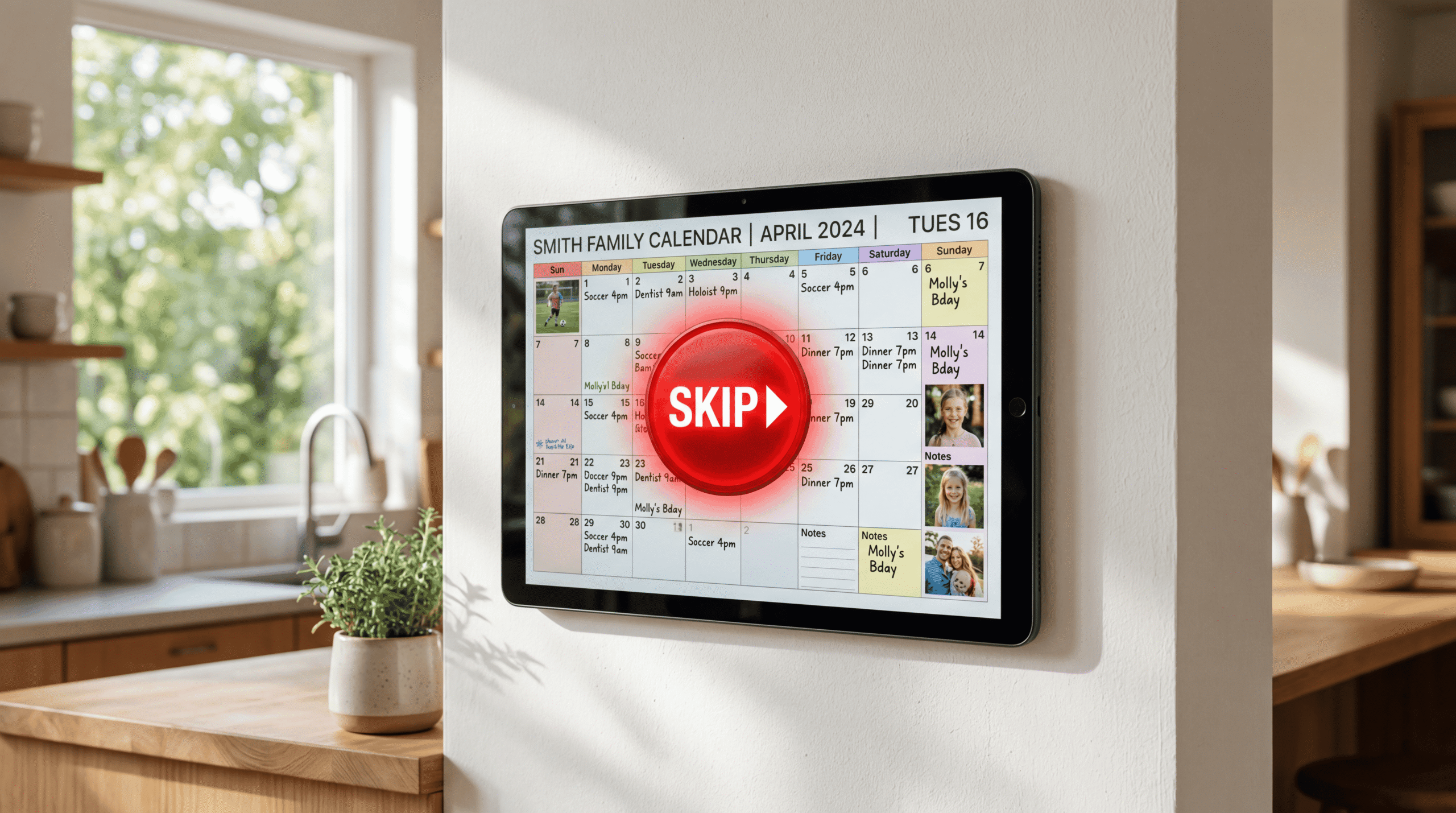

Skylight wants to sell your family a $300 touchscreen calendar. Not because you need one — because they need a business model that survives past the initial hardware sale. I spent a week with the Skylight Buddy to figure out if this dedicated family device makes any sense in 2024.
The honest answer: It doesn’t. Not at this price, not with these features, and certainly not when every smartphone already does this better.
What Skylight Buddy Actually Is
Strip away the marketing and the Skylight Buddy is a 15-inch touchscreen running custom Android with a heavily locked-down interface. You get a shared calendar, a chore tracker, photo sharing, and messaging — all tethered to a proprietary cloud service that requires an ongoing subscription after the first year.
The hardware is fine. The 1920×1080 display is bright enough for kitchen counters. The interface responds quickly. The magnetic mount works as advertised. But “fine” hardware at $299 doesn’t justify the fundamental product decision here: dedicating an entire device to tasks that every parent’s phone already handles.
According to The Verge’s hands-on review, the device ships with a year of cloud service included, then switches to a subscription model. That’s the tell — Skylight isn’t selling you a product, they’re recruiting you into a service they’ll charge for annually.
The Features That Don’t Actually Solve Anything
Skylight positions the Buddy as solving screen time anxiety. Your kids can check chores and the family calendar without accessing TikTok or YouTube. That’s true. It’s also solving a problem that better parenting and actual device restrictions handle for free.
The chore tracker lets you assign tasks and set rewards. Cute. Also available in literally dozens of free apps, including Apple Reminders, Google Tasks, or any of the dedicated chore apps that don’t require a $300 hardware gateway.
The calendar syncs with Google Calendar and Apple Calendar. Great — except you’re already using those calendars on phones your family actually carries everywhere. The Skylight Buddy lives on your kitchen wall. Your phone lives in your pocket. Which one do you think gets checked more?
Photo sharing is the one feature that almost justifies the device. Loading family photos to a dedicated screen your kids can browse without diving into your camera roll has genuine utility. But dedicated digital photo frames from Nixplay or Aura do this better, for less money, without locking you into a calendar ecosystem you don’t need.
What The Press Got Wrong
Most reviews treat the Skylight Buddy as innovative simply because it exists. That’s lazy analysis. Innovation means solving a real problem better than existing solutions. The Buddy doesn’t.
The tech press loves to cover “screen-free alternatives” without interrogating whether adding another screen actually reduces screen time. It doesn’t. It just adds another proprietary platform to manage, another login to remember, another device that will lose vendor support in three years.
The real question nobody’s asking: Why does this need to be hardware? Everything the Skylight Buddy does could ship as an iOS or Android app that runs on a $50 tablet mounted to your wall. The answer is business model — hardware sales provide the revenue bridge while Skylight builds the subscription base they actually want.
The Technical Decisions That Reveal The Strategy
Look at what Skylight locked down and what they left open. You can’t install other apps. You can’t use it as a general-purpose display. You can’t connect external devices. This isn’t a security decision — it’s a vendor lock-in decision.
The device runs Android, which means Skylight spent engineering resources deliberately removing functionality that comes standard. That’s expensive. You don’t invest in removing features unless you’re protecting a business model that depends on customers staying inside your ecosystem.
The subscription pricing tells you everything. Year one is free because Skylight needs initial adoption. After that, they’re betting most customers won’t bother returning the device or canceling. They’re counting on inertia, the same retention strategy every gym and streaming service uses.
According to technical teardowns shared on home automation forums, the underlying hardware is commodity Android components. There’s nothing here that justifies premium pricing except the software lock-in and the branding.
Who Actually Wins and Loses
Skylight wins by establishing a hardware beachhead in family organization before bigger players notice the category. They’re building the Peloton model — initial hardware sale, recurring subscription revenue, brand loyalty from families who bought in early.
Parents lose by paying $300 plus ongoing subscription fees for functionality they already own. Every dollar spent on Skylight is a dollar that could go toward better solutions: actual parental controls, quality time without devices, or saving for things that actually matter.
Kids lose by having technology positioned as a chore management system rather than a tool for creativity and learning. The Buddy reduces family technology to task tracking and calendar management — the most boring possible use case.
Apple and Google win by default. Every family that buys a Skylight Buddy will eventually realize their phones already do this better. The Buddy becomes shelf-ware, and families return to the ecosystems that actually integrate with their lives.
The Alternatives That Actually Work
If you genuinely want a shared family display, buy a $50 Amazon Fire tablet, mount it to your wall, and use Google Calendar or Cozi. Total cost: $50 one-time, zero subscription. Same functionality, better ecosystem integration, replaceable if it breaks.
If you want to manage screen time, use the built-in parental controls on iOS or Android. They’re free, they work across all your family’s devices, and they don’t require dedicated hardware gathering dust when your kids outgrow chore tracking.
If you want a digital photo frame, buy an actual digital photo frame. Nixplay, Aura, and Skylight’s own dedicated photo frames are all better at displaying photos than the Buddy, and they don’t pretend to be organizational tools.
The only scenario where the Skylight Buddy makes sense: you have extended family members who refuse to use smartphones and you want a dead-simple way to share calendar events and photos. Even then, you’re paying a steep premium for simplicity you could achieve with literally any tablet and a launcher app.
The Real Cost Beyond The Price Tag
The Skylight Buddy costs $299 upfront. After year one, the subscription runs $39 annually for basic service or $99 annually for premium features. Over a typical five-year product life, you’re paying $494 for the basic tier or $794 for premium.
That’s not counting the opportunity cost of investing in a closed ecosystem that will inevitably lose vendor support. Skylight is a small company building hardware. Hardware companies die. When they do, your $300 device becomes a brick.
Compare that to spending $50 on a commodity tablet running standard Android. When the tablet dies, you replace it for $50. When the apps you use shut down, you switch to competitors for free. When better solutions emerge, you adopt them without throwing away hardware.
Why This Product Exists Despite Not Making Sense
The Skylight Buddy exists because venture capital rewards founder vision over market validation. Someone pitched “Peloton for family organization” and investors wrote checks. Now Skylight needs to justify that funding with revenue growth, regardless of whether the product solves real problems.
This is how you get dedicated hardware for tasks that commodity devices already handle. It’s not about serving customers better — it’s about creating differentiation that justifies premium pricing and recurring revenue.
The tell is in the marketing. Skylight doesn’t pitch the Buddy as “better than your phone” because they can’t win that argument. Instead, they pitch it as “purposeful” and “distraction-free” — emotional appeals that sidestep direct functionality comparisons.
The Verdict: Save Your Money
The Skylight Buddy is well-executed hardware solving a problem that doesn’t need solving. It’s too expensive for what it does, too limited for what it costs, and too dependent on a subscription model that benefits Skylight more than families.
If your family actually struggles with organization and screen time, the Buddy won’t fix it. Those are behavioral problems requiring intentional parenting, not hardware solutions. Adding another screen to manage screens misses the point entirely.
The only reason to buy a Skylight Buddy is if you value the specific aesthetic of a dedicated family device enough to pay $300 plus subscriptions for it. That’s fine — aesthetic preferences are valid. Just be honest that you’re paying a premium for form factor, not functionality.
For everyone else: skip it. Your phone already does this. Your tablet already does this. Your family already has the tools they need. The Skylight Buddy is a well-marketed solution in search of a problem that stopped existing the moment smartphones became ubiquitous.
Final prediction: In three years, Skylight pivots from dedicated hardware to white-label software for existing smart displays, and the Buddy becomes a cautionary tale about mistaking venture-funded vision for market need.