



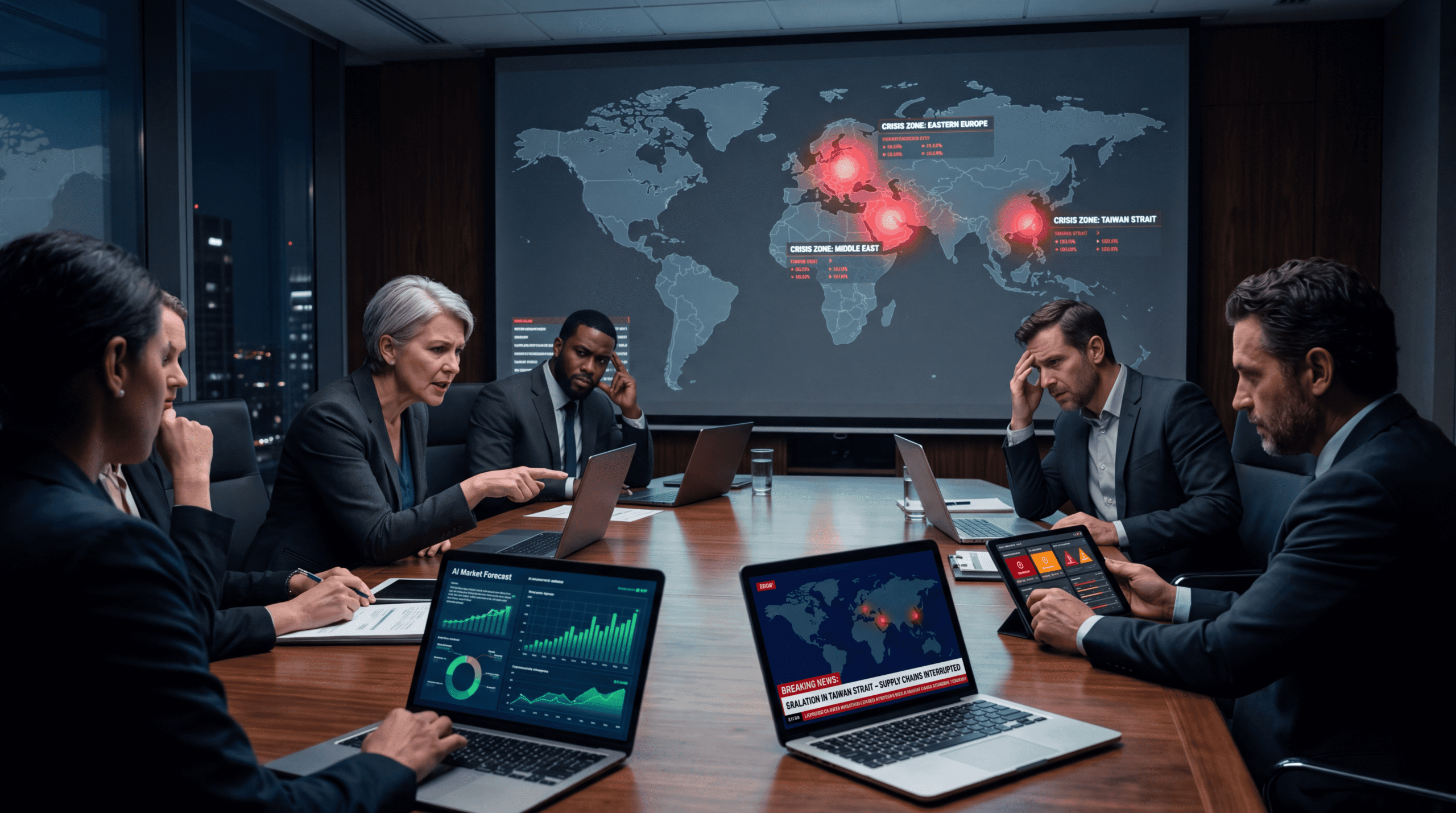

The typical corporate board meeting now opens with a question directors never trained to answer: Which geopolitical crisis will destroy our supply chain first — and can our AI systems see it coming?
After 18 years tracking conflict zones from Kyiv to Gaza, I can tell you this: The gap between what corporate directors know about geopolitical risk and what they need to know has never been wider. And the integration of AI into decision-making hasn’t closed that gap — it’s weaponized their ignorance.
This isn’t another article about “managing uncertainty.” This is about directors who govern trillion-dollar enterprises with the geopolitical literacy of a mid-tier MBA program circa 2015. The world has moved on. Most boardrooms haven’t.
The 72-Hour Window That Changed Everything
When Russia invaded Ukraine in February 2022, I watched corporate boards discover in real-time that they had no functional framework for geopolitical crisis response. Not theoretical risk matrices — actual, executable crisis protocols.
According to McKinsey’s 2024 analysis, 83% of executives reported significant geopolitical events affecting their business in the past year. Yet fewer than 40% of boards had conducted geopolitical risk scenario planning before a crisis struck.
The pattern repeats: Hamas attacks Israel on October 7, 2023. Red Sea shipping collapses within weeks. Boards scramble. Taiwan tensions escalate in April 2024. Semiconductor-dependent companies freeze. Iran-Israel strikes in October 2024. Energy boards convene emergency sessions.
Every time, the same question haunts the boardroom: Why didn’t we see this coming?
AI Was Supposed To Be The Answer
Enter artificial intelligence — sold to directors as the ultimate risk radar. Machine learning algorithms that could parse millions of data points, detect patterns human analysts miss, predict geopolitical flashpoints before they ignite.
The reality? Brookings research shows AI systems trained on historical data are catastrophically bad at predicting genuinely novel geopolitical events. They excel at finding patterns in the past. They fail spectacularly at anticipating the unprecedented.
More concerning: Directors now trust AI-generated risk assessments they don’t understand, created by algorithms they can’t interrogate, based on assumptions they never examined.
I call this “automation bias in the C-suite” — the dangerous tendency to defer to machine judgment precisely because human judgment feels inadequate. When that machine is optimizing for the wrong variables, you’ve just automated bad decisions at board speed.
The Dual Crisis: Geopolitics Meets Algorithmic Governance
The collision of geopolitical instability and AI integration creates a compounding crisis. Consider these parallel developments:
On the geopolitical side: The post-Cold War order is disintegrating. Not evolving — disintegrating. Russia’s invasion of Ukraine shattered the nuclear taboo against territorial conquest in Europe. China’s assertion of control over Taiwan moves from theoretical to operational planning. The Middle East fractures along new fault lines that don’t respect the old alliances.
On the AI side: Corporate dependence on algorithmic decision-making accelerates exactly as geopolitical volatility makes historical pattern-matching unreliable. The algorithms don’t know they’re obsolete. Neither do the directors relying on them.
According to the World Economic Forum’s 2024 Global Risks Report, geopolitical confrontation ranks as the top short-term risk to business operations, while AI-related misinformation ranks fourth. The report doesn’t adequately address what happens when these risks intersect.
I will: You get boards making billion-dollar strategic decisions based on AI models that confidently predict stability in regions approaching conflict. The algorithm says “low risk.” The satellites show troop movements. Directors believe the algorithm.
What This Actually Looks Like In Practice
Let me give you a composite scenario drawn from real boardroom failures I’ve documented:
A major European manufacturer uses AI-powered supply chain optimization. The system recommends concentrating semiconductor sourcing in Taiwan to reduce costs by 18%. Board approves. Six months later, China conducts military exercises that shut down Taiwan Strait shipping for 72 hours.
The AI system flagged “geopolitical risk” at 23% — well within acceptable parameters. What the algorithm couldn’t process: Xi Jinping’s political calculus heading into a crucial party congress, the symbolic importance of Taiwan reunification to Chinese nationalism, or the way U.S.-China tech sanctions were cornering Beijing into high-risk moves.
Those variables aren’t in the training data. They require human expertise in geopolitical analysis that most boards don’t have and most AI systems can’t replicate.
The Skills Gap Killing Corporate Strategy
Here’s the uncomfortable truth: Most corporate directors have never worked in government, never managed operations in an active conflict zone, never participated in geopolitical crisis planning at a strategic level.
They’ve managed quarterly earnings through financial cycles. They haven’t managed supply chains through shooting wars.
The Council on Foreign Relations documented this expertise deficit in their 2023 analysis of Fortune 500 boards. Fewer than 12% of directors had professional backgrounds in international security, diplomatic service, or conflict zone operations. Yet 94% of companies identified geopolitical risk as material to business operations.
You wouldn’t let a board without financial expertise oversee a $10 billion company. Yet boards without geopolitical expertise routinely oversee operations across dozens of countries, multiple conflict zones, and overlapping spheres of great power competition.
What This Means For You
If you’re a shareholder, you need to ask your board: Who on this board has actually managed operations through a geopolitical crisis? Not theoretically studied one — managed through one.
If you’re an employee, you need to understand: Your company’s strategic planning likely assumes a level of geopolitical stability that no longer exists. That affects your job security in ways your HR department isn’t discussing.
If you’re a mid-level executive, you’re caught in the worst position: Responsible for executing strategies based on geopolitical assumptions you know are wrong, but lacking the authority to challenge the AI-generated risk assessments the C-suite treats as gospel.
The real cost of boardroom geopolitical illiteracy isn’t paid by directors. It’s paid by workers laid off when supply chains collapse, communities abandoned when factories relocate overnight, and shareholders who watch billions evaporate because the board approved expansion into a region experts knew was unstable.
The AI Acceleration Problem
Artificial intelligence doesn’t just fail to solve the geopolitical expertise gap — it actively makes it worse by creating the illusion of sophisticated analysis.
I’ve watched boards review AI-generated geopolitical risk dashboards that are essentially useless: Heat maps showing “risk levels” across regions, trend lines projecting “stability indices,” confidence intervals that mean nothing because the underlying model doesn’t understand the difference between statistical volatility and actual political revolution.
The danger isn’t that AI provides bad information. The danger is that it provides superficially plausible information that passes for expertise in rooms where nobody has the background to challenge it.
Recent Brookings analysis on AI governance highlights another dimension: The geopolitical competition over AI development itself creates risks that AI systems can’t model. When the U.S. restricts chip exports to China, when China mandates data localization, when the EU implements AI regulations that diverge from American standards — these aren’t variables an algorithm optimized for cost and efficiency can properly weigh.
They require strategic judgment about how great power competition reshapes the business environment. That’s a human skill, not a computational one.
What Happens Next: Three Scenarios
Scenario One: Painful Education Through Crisis
Most likely outcome. Boards continue operating with inadequate geopolitical expertise until a major crisis forces emergency restructuring. Multiple companies simultaneously discover their AI-optimized supply chains all failed the same way, for the same geopolitical reasons their models couldn’t process. Regulatory pressure follows. Boards scramble to add international security experts. The lesson costs billions and takes years.
Scenario Two: Regulatory Intervention
Moderately likely. Securities regulators, particularly in the EU and UK, begin requiring disclosure of board-level geopolitical risk expertise and AI governance frameworks. Companies that can’t demonstrate adequate capabilities face investor skepticism and potential liability. Market pressure forces earlier board composition changes than Scenario One, but still reactive rather than proactive.
Scenario Three: Competitive Advantage Through Foresight
Least likely, highest payoff. A small cohort of companies aggressively recruits directors with genuine geopolitical expertise and implements hybrid decision frameworks that combine AI analytical power with human strategic judgment on context-dependent risks. These companies consistently outperform during crises because they see disruptions coming and position accordingly. Market rewards them. Others copy. Best practices emerge — but only after the competitive gap becomes undeniable.
The Integration That’s Actually Needed
Here’s what functional boardroom geopolitical risk management looks like — and it’s rare:
Directors with real operational experience in geopolitically complex environments. Not consultants who did a study tour. People who ran manufacturing in Ukraine during the 2014 crisis, managed teams through Hong Kong’s political transition, or navigated sanctions compliance when Iran nuclear talks collapsed.
AI systems used as analytical tools, not decision makers. The algorithm identifies anomalies and patterns. The human expert interprets whether those patterns matter in current geopolitical context.
Scenario planning that goes beyond financial stress testing to include actual war game exercises. What if Taiwan becomes inaccessible for 90 days? What if Saudi-Iran tensions close Hormuz? What if India-China border conflict disrupts South Asian supply chains? Run the scenarios. Make decisions in simulation. Find your gaps before they become catastrophic.
Quarterly geopolitical briefings from actual experts — intelligence community veterans, former diplomatic corps, conflict zone NGO leaders. People who know what indicators actually predict violence, state collapse, or sudden regulatory change.
None of this is happening at scale. Most boards get their geopolitical analysis from the same consulting firms delivering their digital transformation strategies. It’s inadequate for the environment we’re entering.
Why This Matters More Than ESG or DEI
Corporate boards have spent the last five years intensely focused on environmental, social, and governance factors. Important work. But here’s the hierarchy of risk they’re missing:
ESG doesn’t matter if your primary manufacturing region becomes a war zone. Diversity initiatives don’t matter if geopolitical crisis wipes out your business model overnight. Climate commitments don’t matter if you lack the geopolitical expertise to navigate the resource conflicts climate change is already creating.
Geopolitical risk is the meta-risk that determines whether you’ll be around to address all the other risks. And it’s the one risk area where boards have made the least progress on capability building.
The Accountability Gap
When a company fails financially, we can point to specific board decisions, specific oversight failures, specific fiduciary breaches. When a company fails geopolitically — supply chain collapses due to war, assets seized due to sanctions, operations disrupted due to conflict — accountability vanishes into claims of “unforeseeable circumstances.”
Except they were foreseeable. Just not by the people making the decisions.
I’ve watched companies lose billions in Russia after the 2022 invasion and claim force majeure. I tracked analysts who warned those same companies in 2021 that Putin was likely to invade and that Western sanctions would be severe. The warnings existed. They never reached boardrooms in actionable form.
That’s a governance failure, not an intelligence failure. And it’s repeating right now with China-Taiwan risk, Middle East exposure, and technology supply chain concentration.
The Choice Ahead
Corporate boards face a decision they haven’t quite acknowledged yet: Continue governing in a geopolitical environment they don’t understand, augmented by AI systems that amplify their blind spots, or fundamentally restructure board composition and decision-making to match the complexity of the world they’re operating in.
Most will choose the former by default. A few will choose the latter strategically. The performance gap between these two groups over the next decade will be historic.
The companies that get this right will have directors who can interpret what China’s Third Plenum decisions mean for semiconductor strategy, who understand how Middle East realignment affects energy futures, who can distinguish between AI-identified statistical anomalies and genuine geopolitical inflection points.
The companies that get this wrong will keep asking “Why didn’t we see this coming?” while their algorithms confidently predict stability right up until the moment everything breaks.
The question isn’t whether the next geopolitical crisis will hit your boardroom — it’s whether your board will recognize it’s happening before your competitors already moved.